Where AI is strong. Where it breaks. And why.
Where Artificial Meets Cognitive Intelligence
A unifying theory exploring how AI systems and human cognition intersect, overlap and co-evolve. For researchers, developers, educators and curious minds.
CURRENT AI
Statistical learning at scale
• Derives competence from large-scale correlation over massive datasets.
• “Reasoning” is a downstream effect of statistical learning, not independent cognition.
• Excellent at complexity, but blind to entropy and ambiguity.
• Cannot detect when its own model is breaking down.
• Confidently wrong when conditions shift outside training data.
Human Intelligence
Reasoning with little or no data
• Humans can reason with little or no data, even newborns. • Infants begin with zero experiential training set.
• Must possess latent cognitive capacities beyond learned correlations.
• Evolved to survive entropy and ambiguity, not just process complexity.
• Detects epistemic breakdown and adapts: caution, exploration, creativity.
The Bootstrapping Problem
The gap is structural, not incremental. If human cognition develops from near-zero data, then humans must possess latent cognitive capacities that are not reducible to learned correlations alone.
All intelligent systems — biological and artificial — must contend with these three properties. They differ in how well they cope.
C
Complexity
Definition
Information that can be accurately encoded and whose internal relationships can be determined. Rich, structured, extractable.
E
Entropy
Definition
Information that cannot be accurately encoded or predicted. Small variations can radically alter meaning, as in chaos theory.
A
Ambiguity
Definition
Information that, when encoded, may be interpreted to have more than one meaning, from insufficient data or from too much overlapping detail.
1. Unobserved
Raw Reality
Information as it exists before any observer
Raw reality holds information from all possible perspectives. It may be in a steady state or subject to rapid entropic decay. What exists now may be lost to any future observer entirely.
EXAMPLE
A mouse hidden in long grass exists as unobserved information. Present in reality, but not yet encoded by any observer.
2. Observed
Observer-Filtered
Reality encoded through sensory and cognitive constraints
What results after an observer encodes reality through their particular sensory and cognitive constraints. Different observers produce different observed information from the same world.
EXAMPLE
A bird of prey spots the mouse. A human sees only a uniform blanket of grass. Same raw reality, entirely different observed information.
3. Interpreted
Symbol-Mapped
Observed information correlated to known symbols
Classification or tokenisation against known symbols, based on objective functions. Always lossy. Carries an unavoidable error term, Epsilon (ε), that grows when upstream entropy is high.
On Epsilon (ε)
Entropy in unobserved and observed states amplifies ε in ways the objective function cannot account for. This is where AI confidence breaks down.
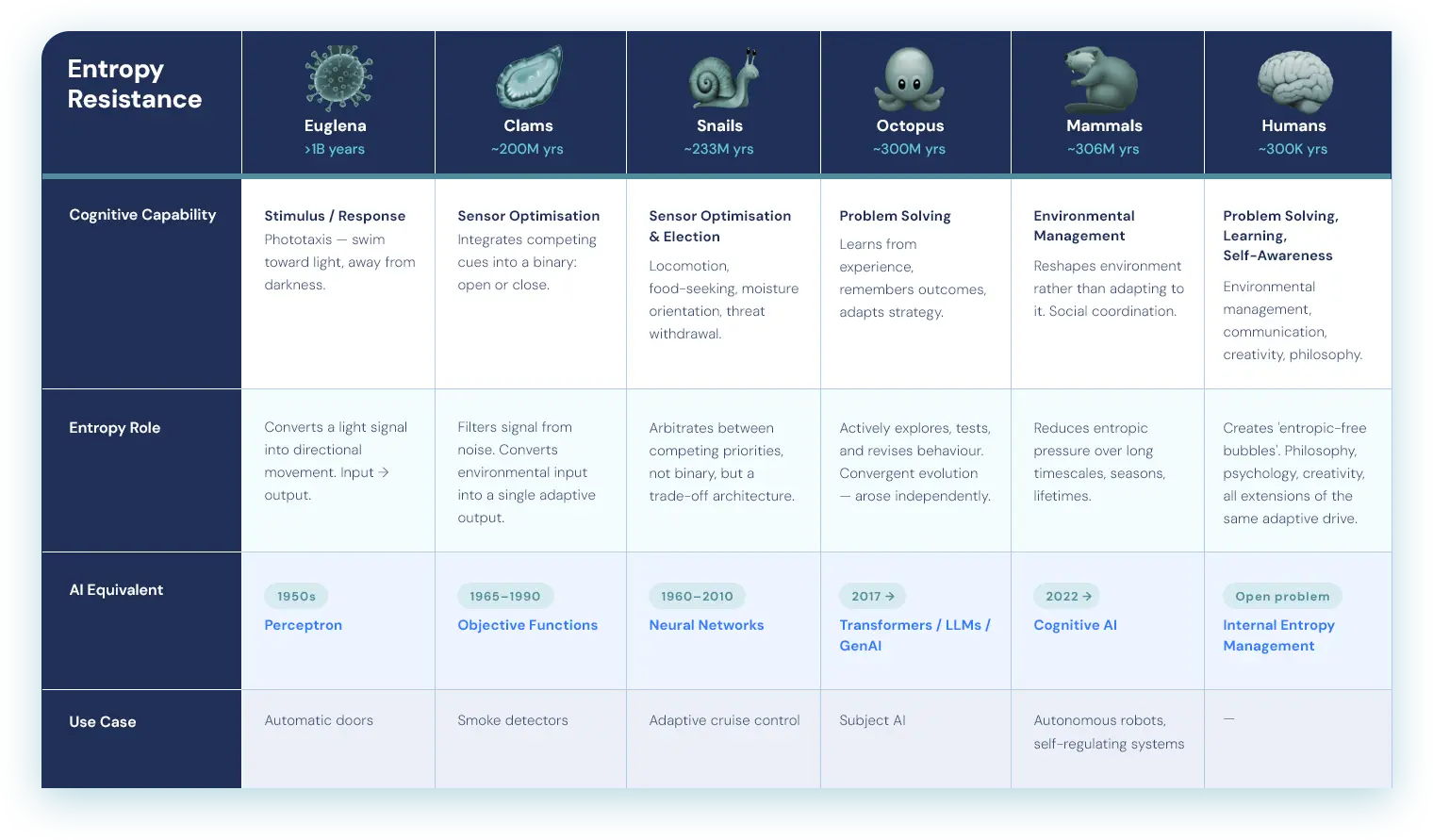
BIOLOGICAL COGNITIVE EVOLUTION
From stimulus-response to self-awareness
Cognitive ability can be traced through evolution as increasingly sophisticated entropy-resistance strategies.
The purposes of the Institute are exclusively charitable and, without limiting the generality of the foregoing, are:
To advance education by conducting, supporting and disseminating scholarly and scientific research into cognitive information theory and into the structural, mathematical, computational and biological foundations of cognition, and by making the results of such research publicly available to researchers, students, educators and the public.
To advance education by establishing and operating educational programs, courses, lectures, seminars, workshops, symposia, conferences and publications on the subjects of cognitive information theory, information theory, decision theory, computational cognition, the foundations of artificial intelligence, neuroscience, the philosophy of mind, evolutionary cognition and related disciplines, and by making the educational materials produced thereby publicly available.

To advance education by providing scholarships, fellowships, bursaries, research grants and similar awards, on the basis of academic merit and demonstrated capacity to contribute to the advancement of knowledge in the fields described in paragraphs (1) and (2), to qualified researchers and students at recognized educational institutions in Canada and elsewhere.