
Intelligence isn’t a gift added to biology. It’s a tool forged by survival pressure. Every cognitive capacity we possess, from a single cell sensing light to a human building a philosophy, exists because resisting disorder demands it.
This page builds on the Foundations of CIT, which explains the three properties of information: Complexity (structured, predictable), Entropy (unpredictable, the driver of cognitive evolution), and Ambiguity (open to multiple meanings). The evolutionary story is the story of living systems becoming progressively better at managing all three.
01 THE ANCHOR
Life is defined by its resistance to disorder
In 1944, physicist Erwin Schrödinger offered a deceptively simple observation. It reframes everything we think about living systems, and by extension, about intelligence itself.
“Life feeds on negative entropy.”
Erwin Schrödinger, What Is Life? (1944)
This isn’t a metaphor. It’s a functional description of what separates a living thing from an inert object. When it rains, a rock sits unmoved and gets wet, eventually eroded. A land snail, by contrast, shelters under leaves and rocks. The snail doesn’t reason about this. It doesn’t have a plan. But it detects disorder in its environment and acts to reduce it. The rock cannot.
INERT MATTER
A rock in rain undergoes change: it gets wet, eventually erodes. It does not register entropy as threat or urgency. It simply is changed. No detection. No response.
LIVING SYSTEM
A land snail shelters. Even this primitive organism detects disorder and acts to reduce it. Entropy is registered as a signal. That signal is the foundation of every cognitive capacity that followed.
This gives us an immediate insight into current AI. A system that processes information with extraordinary power but is blind to entropy is, in the deepest sense, not alive. What we observe is a ghost in the machine effect: latent entropy encoded in the data that AI was trained on creates patterns we interpret signs of life from the output, rather than life actually existing.
02 THE EVOLUTIONARY RECORD
From a single cell to self-awareness: One unbroken story
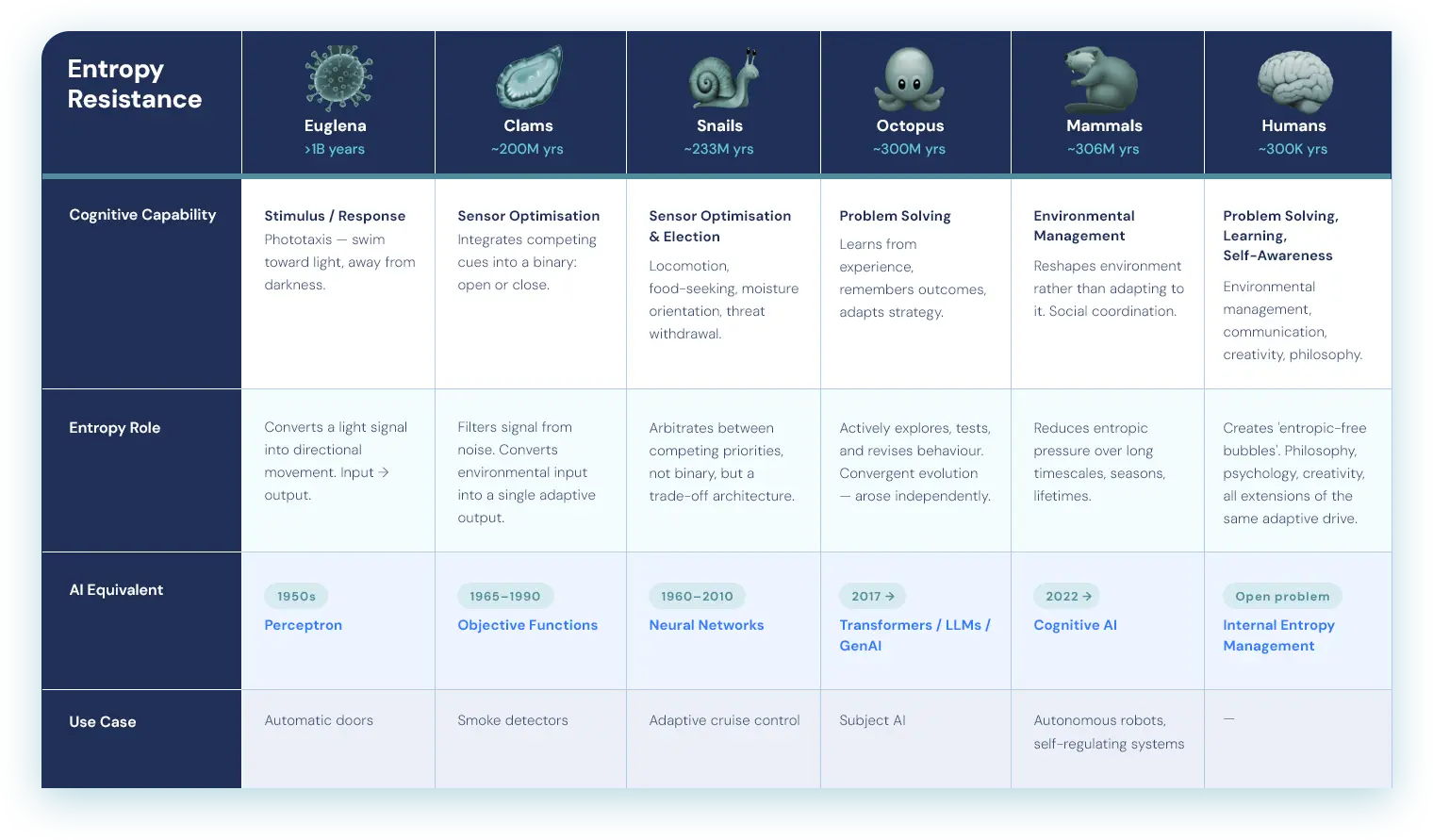
Just as the human eye can be traced back through evolution from a single photosensitive cell to the complex lens-and-retina structure we have today, cognitive ability can be traced as an unbroken line of increasingly sophisticated strategies for resisting entropy. Each step was not random. It was rewarded by survival.
>1 BILLION YEARS AGO
Euglena
A single-celled organism that swims toward favorable light and away from darkness. Not cognition in any reflective sense, but the first recognizable cognitive act: sensing a gradient of disorder and moving away from it. The same basic architecture as a single perceptron in artificial intelligence.
The cognitive leap: input triggers output. Entropy is detected and acted upon.
>233 MILLION YEARS AGO
Freshwater Clams
Clams must integrate many competing sensory cues into a single decision: open to feed, or close to protect. This is more complex than a simple stimulusresponse. It resembles a neural network weighing many inputs and producing one output that minimizes risk.
The cognitive leap: multiple signals, one decision. The first balancing act.
>200 MILLION YEARS AGO
Snails
A snail can move toward food, follow moisture, shelter from threat, and withdraw into its shell. It must continually arbitrate between competing priorities. This is no longer a single choice but a continuous, weighted negotiation between different survival pressures.
The cognitive leap: competing priorities managed in real time.
>300 MILLION YEARS AGO
Octopus
The octopus learns from experience, remembers outcomes, and adapts its approach when conditions change. It solves novel problems and explores its environment with genuine curiosity. What makes the octopus particularly significant is that sophisticated cognition evolved here independently, on a completely different lineage from mammals. This makes advanced intelligence look less like a lucky accident and more like a repeatedly rewarded evolutionary strategy.
The cognitive leap: learning from experience. Intelligence as an autonomous survival tool.
>306 MILLION YEARS AGO
Mammals
A fundamental shift in strategy: rather than simply adapting to the environment, mammals begin to reshape it. Beavers transform rivers into ponds. Wolves coordinate group hunts. Rodents build insulated burrows. Cognition is now used to create stable, predictable conditions, reducing entropy not just in the moment but across seasons and lifetimes.
The cognitive leap: from reacting to the environment to reshaping it.
>300,000 YEARS AGO
Humans
The modern home with heating and air conditioning is the most compelling example of where this journey leads: an “entropic-free bubble” where the environment is maintained exactly as we wish, regardless of conditions outside. We stopped finding shelter from the cold. We made temperature irrelevant. Philosophy, science, and art are simply further expressions of the same drive: converting disorder into understanding.
The cognitive leap: cognition turns inward. We reduce not just physical entropy but existential uncertainty.
Current AI has none of this. A model does not experience uncertainty as danger. It suffers no cost when its internal representations fail to match reality. There is no signal that says “this mismatch matters, and you must update yourself.” AI can simulate problem-solving, but it does not participate in the entropic struggle that makes cognition a genuine survival tool.
03 THE MECHANISM
How information changes as it moves toward understanding
The evolutionary story explains why cognition exists. CIT also describes how it works. All organisms, from clams to humans, process information through three states. Each transition introduces the possibility of error, which is why resisting entropy requires active management at every step.
1
Unobserved
RAW REALITY
The evolutionary story explains why cognition exists. CIT also describes how it works. All organisms, from clams to humans, process information through three states. Each transition introduces the possibility of error, which is why resisting entropy requires active management at every step.
2
Observed
FILTERED BY THE OBSERVER
After an observer encodes reality through their sensory and cognitive constraints. Different observers produce different results from the same raw information. The observer’s limitations become part of the data.
The bird of prey spots the mouse. The human sees only a uniform blanket of grass moving in waves. Same world. Different observations.
3
Interpreted
ALWAYS LOSSY
After an observer encodes reality through their sensory and cognitive constraints. Different observers produce different results from the same raw information. The observer’s limitations become part of the data.
The bird of prey spots the mouse. The human sees only a uniform blanket of grass moving in waves. Same world. Different observations.
04 HUMAN COGNITION
Entropy as the master signal
The evolutionary account above shows that entropy sensitivity is built into living systems as a whole. But research suggests it runs even deeper than that, right down to individual biological variation.
Developmental psychologist Jerome Kagan conducted a landmark longitudinal study at Harvard, observing responses of four-month-old infants to novel stimuli, then following the same individuals through to adulthood. Infants who reacted strongly to unexpected events tended to develop cautious, inhibited behavioral profiles. Those who reacted mildly tended toward boldness and sociability. These patterns were stable across decades, observable long before learning or cultural influence could account for them. A follow-up using MRI scans found the differences were physically anchored in neural architecture.
In other words: sensitivity to entropy is biologically grounded, individually variable, and structurally built into the brain. It is not a learned response. It is a foundational feature of what it means to be a cognitive organism.
When entropy is encountered, CIT identifies three possible responses. Together, they describe the full repertoire of cognitive adaptation.
1
Survival: Fight or Flight
The entropic event triggers a survival response before any higher interpretation is needed. The organism’s first priority is to reduce exposure to uncertainty, not explain it. Some nervous systems register novelty itself as danger.
2
Optimization: Refine the Model
The system already has a working model of the world, but the entropic event reveals a calibration mismatch. Cognition adjusts the response without rebuilding from scratch. The model is refined, not replaced. This is the most common form of everyday learning.
3
Learn: Build Something New
Sometimes the stimulus is genuinely new and no existing model fits. The organism must construct new internal structure: new predictions, new associations, new ways of acting. Entropy is converted into understanding. This is learning in its fullest sense, and it is the foundation of creativity.
Descartes declared I think, therefore I am. Biological cognition theory suggests the correction runs the other way: I am, therefore I think. Thinking is not a metaphysical gift. It is a consequence of evolutionary adaptation to entropic pressure.
05 THE HIGHEST EXPRESSION
Philosophy, psychology, and creativity as entropy management
If cognitive ability evolved to reduce entropy, then even our highest intellectual pursuits are extensions of the same drive. Philosophy, psychology, and creativity are not separate from biology. They are its most refined expressions.
Entropic Philosophy begins from the premise that philosophical reflection is the continuation of the same adaptive process at a higher level. It is cognition attempting to reduce existential entropy, building coherent models of meaning and value that can guide us beyond immediate stimulus. Our awareness of space, time, and self is not incidental. It is functional, built from biological drivers that force us to detect mismatch and transform novelty into understanding.
Entropic Psychology frames the human mind as a system whose primary function is to detect and reduce uncertainty across both inner and outer experience. A welladapted mind is not one that feels good at all times. It is one that can metabolize disruption into stability. By contrast, a troubled mind doesn’t merely suffer within chaos. It begins generating chaos internally, through rumination, hypervigilance, and rigid narratives that no longer match reality.
Entropic Creativity is what happens when the mind encounters uncertainty it cannot resolve passively: a gap, a contradiction, an unsolved problem. It is compelled to generate new structure. Early humans could not prevent earthquakes, but they created myths and narratives that transformed raw uncertainty into something interpretable and communicable. Art, music, and religion are symbolic technologies for reducing internal entropy. They work even when external reality cannot be controlled.
THE CONCLUSION
Cognition is not a gift. It is an evolutionary instrument, forged by a billion years of entropy.
The evolutionary record makes a single, coherent argument: every cognitive capacity we possess exists because resisting disorder was rewarded by survival. From a Euglena sensing light to a human building a philosophy, the drive is the same. The sophistication differs only in degree.
This is why CIT proposes that truly intelligent systems, artificial or otherwise, cannot treat uncertainty as a nuisance to be patched over. They must be built to detect it, respond to it, and grow from it. Not because this is an interesting design choice, but because a billion years of biology suggests there is no other way.